
Quick Answer
Review the report in this order: is the problem precisely defined; is suspect stock contained; is the occurrence cause supported by evidence; is the escape cause separately identified; does each corrective action address a verified cause; are implementation and effectiveness checks measurable; and are affected lots and owners clear? “Operator retrained” or “inspection increased” may be part of a plan, but does not by itself prove the process cause has been removed.
Factory Scenario: The Part Was Wrong and the Check Passed It
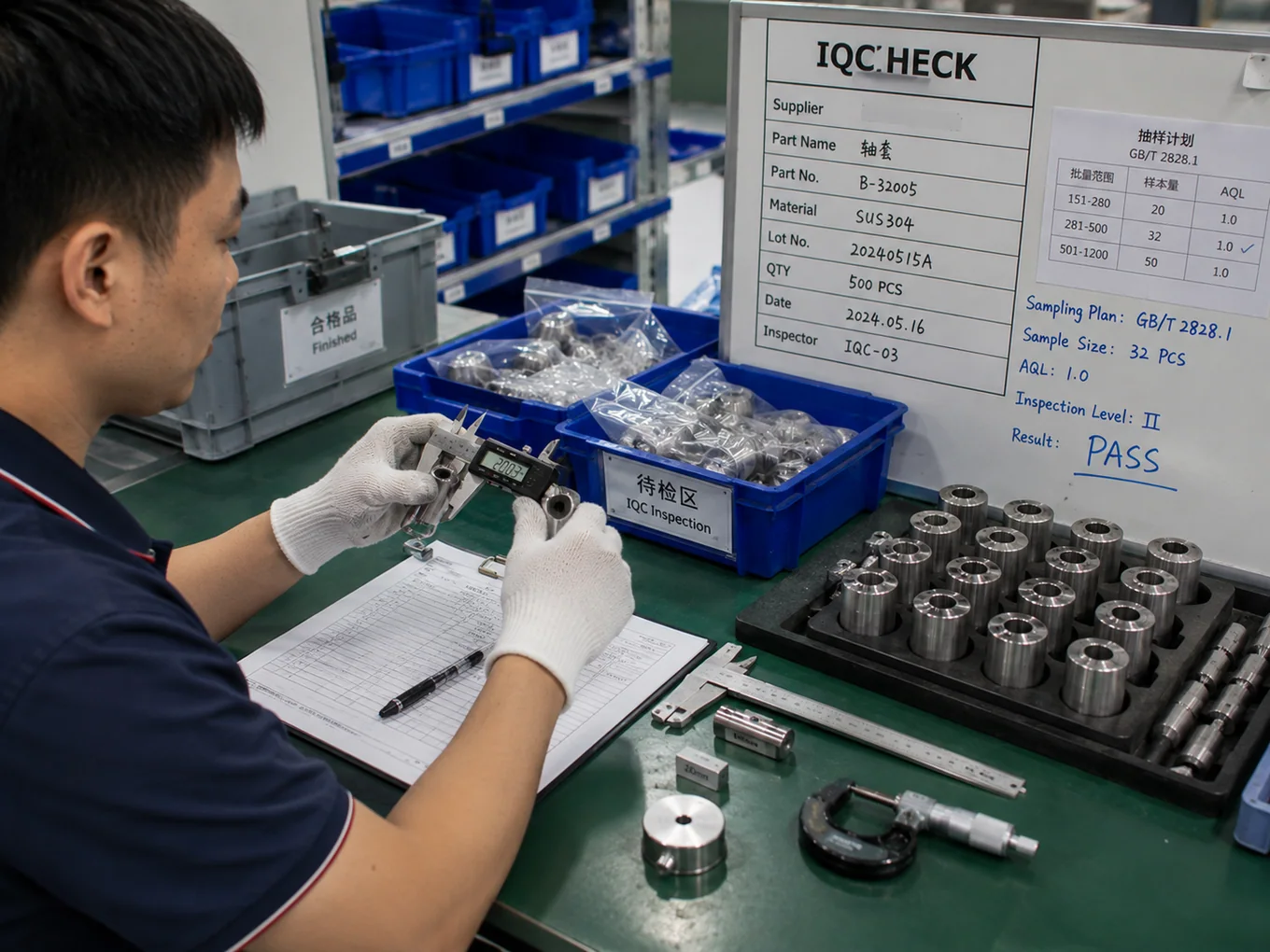
In an illustrative case, a machined feature is out of position, yet the outgoing record shows a pass. The investigation needs two paths. The occurrence path asks how the process produced the wrong position: setup, datum, fixture wear, program revision, clamping, or another verified factor. The escape path asks why the check did not catch it: wrong measurement datum, sampling gap, unclear work instruction, unsuitable gauge, or a record linked to a different revision.
If the report names only “operator error,” it may be stopping at a person rather than a controllable process condition. If it says “inspection missed it,” it has named the escape but may not explain how the nonconformity was created. This scenario is illustrative, not a claimed Nbfeiyu incident.
Read the Problem Statement Before the Root Cause
The opening description should include the requirement, actual condition, where and when it was found, affected part/revision/lot, quantity known, and the detection method. A useful problem statement is specific enough that the supplier, buyer, and inspector would identify the same failure. If the requirement or affected scope is vague, root-cause analysis can be precise about the wrong problem.
Containment should say which locations were checked: work in process, finished goods, warehouse, shipments in transit, and possibly customer stock. Ask for quantities checked and the rule used to identify suspect units. “All stock checked” needs a bounded population and evidence.
Separate Occurrence From Escape
| Review question | Occurrence cause | Escape cause |
|---|---|---|
| What failed? | Process created a nonconforming feature | Control did not identify or stop it |
| Evidence to look for | Setup records, tool/fixture condition, process data, revision history | Inspection method, gauge status, sampling, instructions, reaction plan |
| Weak answer | “Carelessness” with no process evidence | “Inspector missed it” with no control analysis |
| Stronger action | Remove or control the verified process mechanism | Improve the detection/reaction system and prove it catches the condition |
The two causes may interact, but should not be collapsed into one generic statement. The supplier should explain how the team tested possible causes and why alternatives were ruled out. A fishbone or 5-Why diagram is only a thinking aid; it is not evidence on its own.
Test Whether the Corrective Action Matches the Cause
For each verified cause, ask what changed in the process, who owns the change, when it became effective, and what record proves implementation. Then ask how effectiveness will be checked. A better inspection may contain an escape but leave the occurrence cause intact. A fixture change may address occurrence but still leave an inadequate detection plan.
Effectiveness criteria should be agreed and relevant to the defect. They may involve a defined number of production lots or a period of monitoring, depending on risk and volume. Avoid inventing a universal lot count: the buyer and supplier should choose evidence appropriate to the process, defect severity, and customer requirements. If the action fails the agreed check, the corrective-action loop remains open.
Questions That Expose a Thin 8D
During review, ask the supplier to show the evidence behind each key statement:
- Which exact product, revision, process step, and time window were investigated?
- How was the suspect population bounded, and what evidence supports the clean point?
- What observations or records distinguish the selected occurrence cause from other possible causes?
- Which control should have detected the defect, and why did it not trigger a hold or reaction?
- What changed in the process or control plan, and when did the change become effective?
- How will the team verify the correction on subsequent production, and who reviews the results?
These questions are not a script to make the supplier defensive. They make the analysis testable. If an answer is unknown, the report should say what evidence is still being gathered, who owns that work, and when it will be updated. An honest open item is more useful than a confident but unsupported conclusion.
Watch for Common Closure Traps
One trap is confusing containment with correction. A 100% sort may protect the buyer’s current line while the process continues to create the defect. Another is treating a revised inspection as prevention; it may reduce escapes but leave the production mechanism unchanged. A third is closing the report once the replacement shipment arrives, before anyone checks whether the permanent action was implemented.
Also check that the action does not create a new failure mode. A tighter clamp, additional deburring, stronger coating, or revised inspection setup can affect another characteristic. The report should identify relevant side effects and show how they were considered. The degree of validation should match the risk; do not demand unsupported laboratory tests that are unrelated to the failure mechanism.
Link the Report to the Lot and the Release Decision
An 8D should connect to the nonconformance record, affected quantities, disposition, rework or replacement, and the shipment that restored supply. If several part numbers or facilities are involved, identify which scope each action covers and which processes are shared. Do not assume that corrective action on one part automatically applies to similar parts unless the supplier has reviewed the common process and documented that decision.
The buyer can close the immediate product hold while keeping the systemic action open, if the agreed process permits it. Conversely, a complete 8D does not itself authorize use of a nonconforming lot. Keep product release, commercial settlement, and corrective-action effectiveness as distinct approvals with named owners.
Buyer Checklist
- Does the problem statement identify requirement, actual result, revision, location, and scope?
- Is containment evidenced for all relevant inventory and shipment stages?
- Are occurrence and escape causes separately explained?
- Does the evidence support the cause, rather than merely repeat an opinion?
- Does every action address a verified cause and name an owner/date?
- Is effectiveness measurable, time-bounded, and tied to production evidence?
- Are product disposition and corrective-action closure recorded separately?
For how project controls are organized, see Nbfeiyu quality control and the OEM/ODM workflow. If the issue affects supplied components used in an assembly, review assembly and supply-chain support. Additional buyer references are on Manufacturing Resources, and project-specific reviews can be requested through Contact / RFQ.
FAQ
Is an 8D mandatory for every supplier defect?
Not always. Use the response format required by the buyer’s quality system and contract. A smaller issue may use a simpler record; repeated or high-risk failures often justify a formal corrective-action process.
Is retraining an acceptable corrective action?
It can support an action when a verified knowledge or instruction gap exists. It is weak as the sole action if the process still allows the same mistake or the detection control remains ineffective.
When can the buyer close an 8D?
When containment, cause evidence, implementation, and effectiveness criteria meet the agreed requirements and the correct owner approves closure. A submitted form is not the same as verified closure.
Conclusion
A useful 8D tells a connected story: what failed, how it was contained, why it happened, why it escaped, what changed, and what evidence shows the change works. Reviewing those links is more valuable than grading the report by how many pages it contains.
Need a Project-Specific Quality Review?
Send the released requirement, inspection evidence, lot scope, and supplier response. Nbfeiyu can discuss manufacturing controls and project documentation against the agreed specifications.